
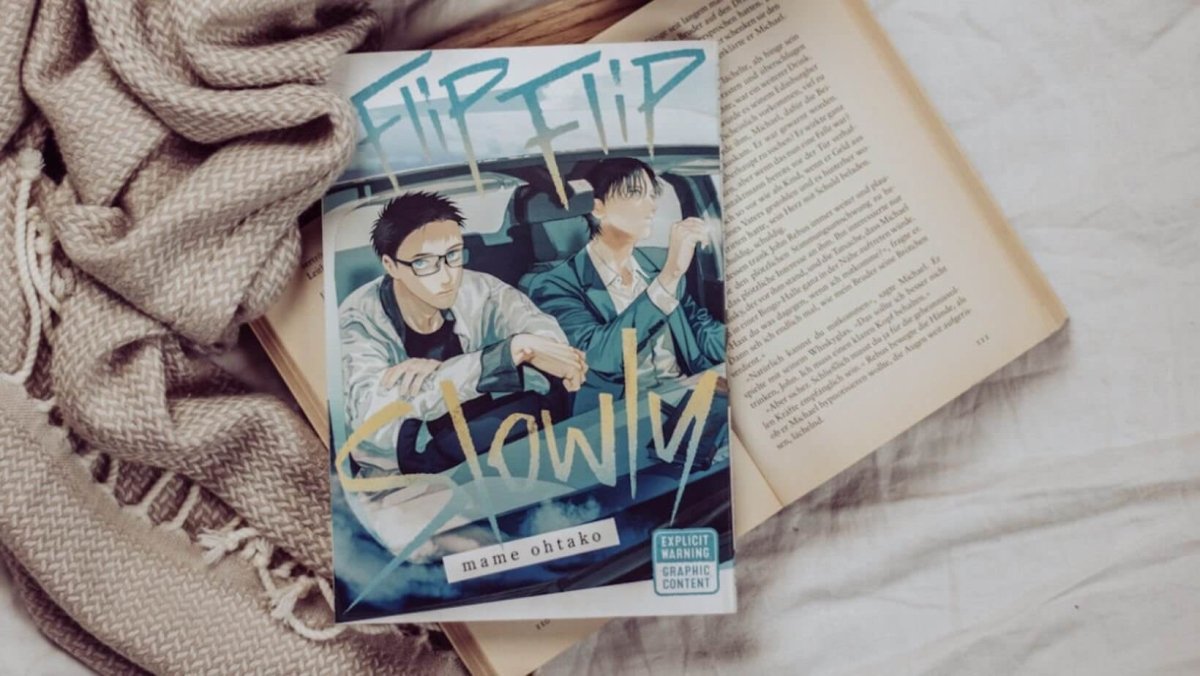
With “Flip Flip Slowly,” I’m introducing another Boys’ Love standalone volume today. It is the second work by mangaka Mame Ohtako, following Play after Call, which was released in France among other places. In Japan, the manga was published from December 2021 to August 2022 in the Boys’ Love magazine gateau by Kodansha.
This work marks the mangaka’s first US release.
How was it?
“Flip Flip Slowly” is a story that does not rely on major twists or dramatic cliffhangers, but instead shows how two people gradually lose the distance between them step by step.
At the center are Hagiwara, a young librarian in a rural area, and Yabumi, who suddenly begins appearing regularly at the library. At first it is simply observation: his punctuality, the way he methodically “works through” the books of a particular author, his quiet, controlled presence. Yet this very “unremarkable” quality is exactly what draws Hagiwara in. Here, closeness does not emerge through grand gestures, but through repeated encounters—later through shared car rides, fragments of conversation, or exchanged glances.
From the beginning, the relationship between the two is marked by an imbalance. Yabumi realizes early on that Hagiwara is attracted to him and draws a clear boundary even before any confession can be spoken. This evasion, however, is not a game but an expression of experience and self-protection. The more one learns about Yabumi, the clearer it becomes that his restraint stems from a past shaped by family conflicts, rejection, and the early awareness of being different. His return to his hometown is less a new beginning than a kind of standstill.
Hagiwara forms a deliberate counterpoint. He is younger, more open, and more direct about his feelings without ever becoming intrusive. There is something fearless about his honesty, almost courageous. He recognizes Yabumi’s wounds and respects them, yet he does not allow them to keep him completely at a distance. It is precisely this combination of consideration and persistence that makes his role so important to the story’s dynamic.
Narratively, “Flip Flip Slowly” is characterized by a very quiet, almost contemplative structure. The plot unfolds slowly—at times so slowly that it can feel as though one is following an inner emotional state rather than a conventional story. This restraint is both a strength and a weakness. On the one hand, it creates a dense, melancholic atmosphere reminiscent of a film in which long shots say more than dialogue. On the other hand, this style demands patience. Anyone hoping for clear conflicts or a tightly structured narrative might find the manga uneventful.
Visually, the art style supports this mood. The focus lies strongly on faces, glances, and body language. Eyes and small gestures in particular carry much of the emotional weight. Landscapes, interiors, and details are staged carefully but unobtrusively, creating a sense of space and air.
In terms of content, the manga repeatedly brings questions of identity, family, and belonging to the forefront. The love story serves more as a framework than as the true core. Much of the story revolves around living with old wounds, the right to take one’s time, and the possibility of not remaining defined by the past. The erotic content of the series remains very minimal, though it is depicted uncensored.
Kodansha publishes the standalone volume in a larger format. There are no color pages or other special features.
Is Flip Flip Slowly worth reading?
“Flip Flip Slowly” is a story about how one approaches a person who has learned to distrust closeness. It tells of how intimacy takes time, that healing is not spectacular, and that being an adult does not mean no longer feeling fear. It is a quiet, melancholic story that reveals its full effect especially if one is willing to engage with its slow pace.
Fans of quieter Boys’ Love titles with deeper themes and an exploration of sexuality will certainly find something worthwhile here.