Traduction automatique
·
Afficher la description originale en anglais
Masquer la description originale en anglais
Description originale en anglais
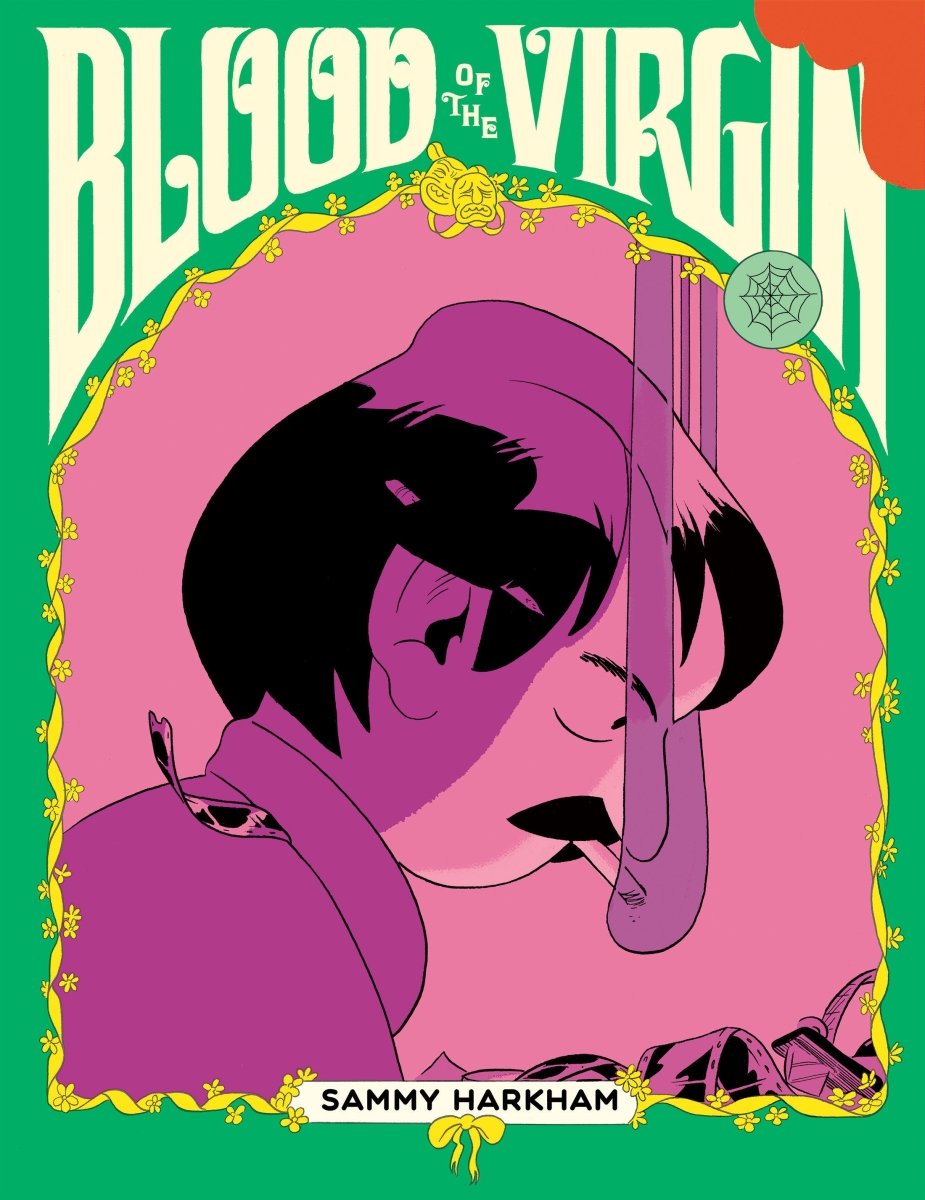
“A story about storytelling...Conjures up the grindhouse movie-making scene in 1970s Los Angeles and tracks an ambitious young man’s flailing attempts to build a family and a career as a film arteest in that debased world...A book with a lot of heart.” —Art Spiegelman, bestselling author of MAUSFourteen years in the making, renowned and beloved graphic novelist Sammy Harkham finally delivers his epic story of artistic ambition, the heartbreak it can bring, and what it means to be humanYOU CAN BURN IN HELL Set primarily in Los Angeles in 1971, Blood of the Virgin is the story of twenty‑seven‑year‑old Seymour, an Iraqi Jewish immigrant film editor who works for an exploitation film production company. Sammy Harkham brings us into the underbelly of Los Angeles during a crucial evolutionary moment in the industry from the last wheeze of the studio system to the rise of independent filmmaking. Seymour, his wife, and their new baby struggle as he tries to make it in the movie business, writing screenplays on spec and pining for the chance to direct. When his boss buys one of his scripts for a project called Blood of the Virgin and gives Seymour the chance to direct it, what follows is a surreal, tragicomic making-of journey. As Seymour’s blind ambition propels the movie, his home life grows increasingly fraught. The film’s production becomes a means to spiral out into time and space, resulting in an epic graphic novel that explores the intersection of twentieth‑century America, parenthood, sex, the immigrant experience, the dawn of early Hollywood, and, shockingly, the Holocaust. Like a cosmic kaleidoscope, Blood of the Virgin shifts and evolves with each panel, widening its context as the story unfolds, building an intricate web of dreams and heartbreak, allowing the reader to zoom in to the novel’s core: the bittersweet cost of coming into one’s own.
« Une histoire sur le fait de raconter des histoires... Évoque la scène du cinéma grindhouse dans le Los Angeles des années 1970 et suit les tentatives maladroites d’un jeune homme ambitieux pour se construire une famille et une carrière comme artiste du cinéma dans ce monde décadent... Un livre avec énormément de cœur. » —Art Spiegelman, auteur best-seller de MAUSAprès quatorze ans de travail, le célèbre et adoré auteur de romans graphiques Sammy Harkham livre enfin son récit épique sur l’ambition artistique, les peines de cœur qu’elle peut provoquer, et ce que signifie être humainYOU CAN BURN IN HELL Situé principalement à Los Angeles en 1971, Blood of the Virgin raconte l’histoire de Seymour, vingt-sept ans, monteur de films et immigrant juif irakien qui travaille pour une société de production de films d’exploitation. Sammy Harkham nous plonge dans les bas-fonds de Los Angeles à un moment clé de l’évolution de l’industrie, du dernier souffle du système des studios à l’essor du cinéma indépendant. Seymour, sa femme et leur nouveau-né traversent des moments difficiles pendant qu’il essaie de percer dans le milieu du cinéma, en écrivant des scénarios spéculatifs et en rêvant d’avoir enfin la chance de réaliser. Quand son patron achète l’un de ses scripts pour un projet intitulé Blood of the Virgin et lui donne l’occasion de le réaliser, s’ensuit un making-of surréaliste et tragicomique. Tandis que l’ambition aveugle de Seymour fait avancer le film, sa vie de famille devient de plus en plus tendue. La production du film devient un moyen de partir dans une spirale à travers le temps et l’espace, donnant naissance à un roman graphique épique qui explore le croisement entre l’Amérique du XXe siècle, la parentalité, le sexe, l’expérience de l’immigration, les débuts d’Hollywood et, de façon saisissante, la Shoah. Comme un kaléidoscope cosmique, Blood of the Virgin se transforme et évolue à chaque case, élargissant son horizon au fil du récit, tissant une toile complexe de rêves et de chagrins, et permettant au lecteur de zoomer jusqu’au cœur du roman : le prix doux-amer qu’il faut payer pour devenir soi-même.