Traduction automatique
·
Afficher la description originale en anglais
Masquer la description originale en anglais
Description originale en anglais
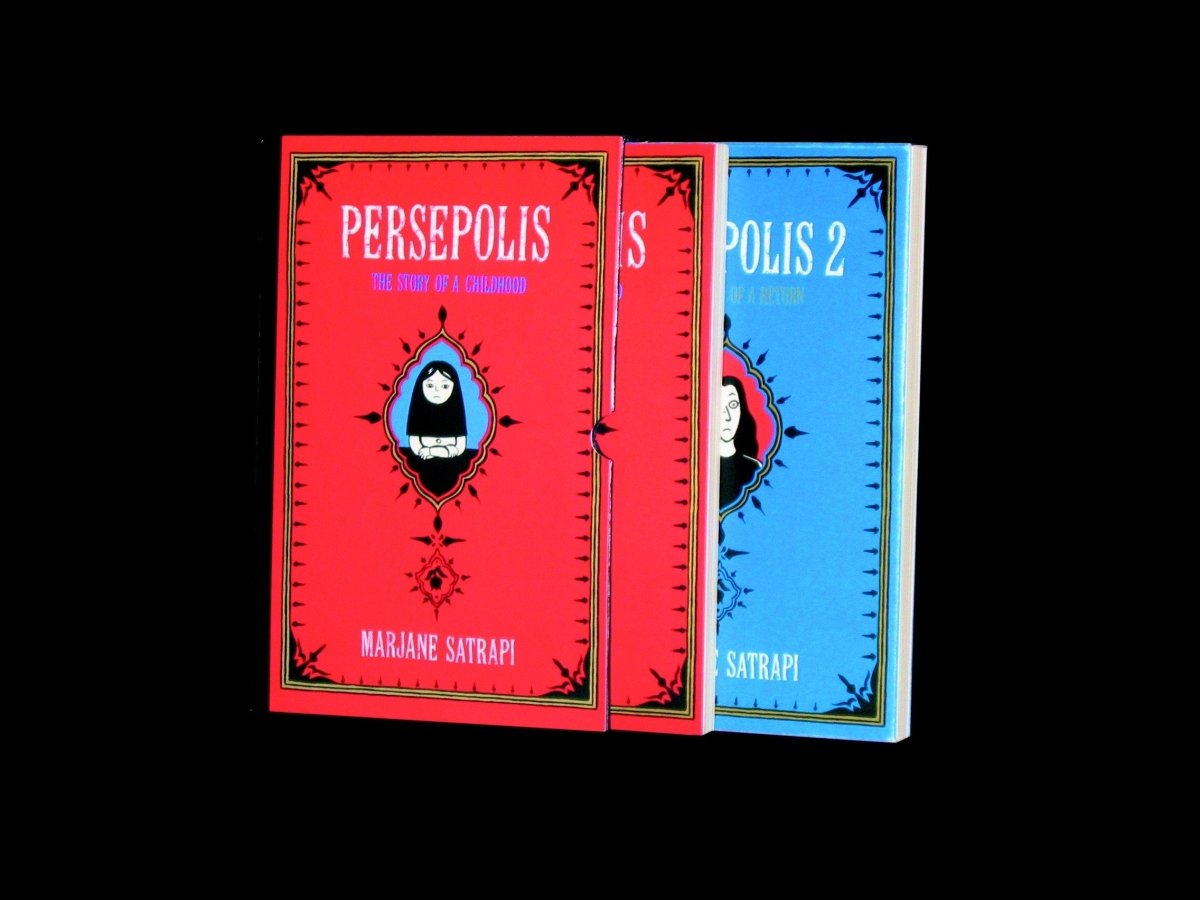
An attractive boxed set of Marjane Satrapi's best-selling, internationally acclaimed graphic memoir of growing up as a girl in revolutionary Iran“A wholly original achievement.... Satrapi evokes herself and her schoolmates coming of age in a world of protests and disappearances.... A stark, shocking impact.” —The New York Times: "The 50 Best Memoirs of the Past 50 Years"Persepolis: The Story of a Childhood Wise, funny, and heartbreaking, Persepolis is Marjane Satrapi’s memoir of growing up in Iran during the Islamic Revolution. In powerful black-and-white comic strip images, Satrapi tells the story of her life in Tehran from ages six to fourteen, years that saw the overthrow of the Shah’s regime, the triumph of the Islamic Revolution, and the devastating effects of war with Iraq. The intelligent and outspoken only child of committed Marxists and the great-granddaughter of one of Iran’s last emperors, Marjane bears witness to a childhood uniquely entwined with the history of her country. Persepolis paints an unforgettable portrait of daily life in Iran and of the bewildering contradictions between home life and public life. Marjane’s child’s-eye view of dethroned emperors, state-sanctioned whippings, and heroes of the revolution allows us to learn as she does the history of this fascinating country and of her own extraordinary family. Intensely personal, profoundly political, and wholly original, Persepolis is at once a story of growing up and a reminder of the human cost of war and political repression. It shows how we carry on, with laughter and tears, in the face of absurdity. And, finally, it introduces us to an irresistible little girl with whom we cannot help but fall in love. Persepolis 2: The Story of a Return Here is the continuation of Marjane Satrapi's fascinating story. In 1984, Marjane flees fundamentalism and the war with Iraq to begin a new life in Vienna. Once there, she faces the trials of adolescence far from her friends and family, and while she soon carves out a place for herself among a group of fellow outsiders, she continues to struggle for a sense of belonging. Finding that she misses her home more than she can stand, Marjane returns to Iran after graduation. Her difficult homecoming forces her to confront the changes both she and her country have undergone in her absence and her shame at what she perceives as her failure in Austria. Marjane allows her past to weigh heavily on her until she finds some like-minded friends, falls in love, and begins studying art at a university. However, the repression and state-sanctioned chauvinism eventually lead her to question whether she can have a future in Iran. As funny and poignant as its predecessor, Persepolis 2 is another clear-eyed and searing condemnation of the human cost of fundamentalism. In its depiction of the struggles of growing up—here compounded by Marjane’s status as an outsider both abroad and at home—it is raw, honest, and incredibly illuminating.
Un superbe coffret réunissant le best-seller de Marjane Satrapi, ce roman graphique autobiographique acclamé dans le monde entier sur son enfance de jeune fille dans l’Iran révolutionnaire. « Une œuvre totalement originale.... Satrapi se représente, ainsi que ses camarades de classe, en train de grandir dans un monde de manifestations et de disparitions.... Un impact saisissant, bouleversant. » —The New York Times: "The 50 Best Memoirs of the Past 50 Years"Persepolis: The Story of a Childhood Drôle, touchant et déchirant, Persepolis est le récit autobiographique de Marjane Satrapi sur son enfance en Iran pendant la Révolution islamique. À travers de puissantes images en noir et blanc façon bande dessinée, Satrapi raconte sa vie à Téhéran de ses six à ses quatorze ans, une période marquée par la chute du régime du Shah, le triomphe de la Révolution islamique et les effets dévastateurs de la guerre contre l’Irak. Fille unique, intelligente et rebelle, de militants marxistes convaincus, et arrière-petite-fille de l’un des derniers empereurs d’Iran, Marjane témoigne d’une enfance intimement liée à l’histoire de son pays. Persepolis dresse un portrait inoubliable du quotidien en Iran et des contradictions déroutantes entre la vie privée et la vie publique. Le regard d’enfant de Marjane sur les empereurs déchus, les flagellations cautionnées par l’État et les héros de la révolution nous permet de découvrir, en même temps qu’elle, l’histoire de ce pays fascinant et celle de son extraordinaire famille. Intensément personnel, profondément politique et totalement original, Persepolis est à la fois un récit d’apprentissage et un rappel du coût humain de la guerre et de la répression politique. Le livre montre comment on continue à vivre, entre rires et larmes, face à l’absurdité. Et surtout, il nous fait rencontrer une petite fille irrésistible dont on ne peut que tomber amoureux. Persepolis 2: The Story of a Return Voici la suite du fascinant récit de Marjane Satrapi. En 1984, Marjane fuit le fondamentalisme et la guerre contre l’Irak pour commencer une nouvelle vie à Vienne. Une fois sur place, elle affronte les épreuves de l’adolescence loin de ses amis et de sa famille et, même si elle finit vite par trouver sa place parmi une bande d’autres marginaux, elle continue de chercher où elle appartient vraiment. Ne supportant plus le mal du pays, Marjane retourne en Iran après l’obtention de son diplôme. Ce retour difficile l’oblige à affronter les changements que son pays et elle-même ont traversés en son absence, ainsi que la honte qu’elle ressent face à ce qu’elle considère comme son échec en Autriche. Marjane laisse son passé peser lourdement sur elle jusqu’à ce qu’elle trouve des amis qui lui ressemblent, tombe amoureuse et commence des études d’art à l’université. Pourtant, la répression et le chauvinisme cautionné par l’État la poussent finalement à se demander si elle peut vraiment avoir un avenir en Iran. Aussi drôle et poignant que le premier volume, Persepolis 2 est une nouvelle dénonciation lucide et percutante du coût humain du fondamentalisme. Dans sa manière de montrer les difficultés du passage à l’âge adulte — ici encore aggravées par la position d’étrangère de Marjane, aussi bien à l’étranger que chez elle —, c’est un récit brut, honnête et incroyablement éclairant.