
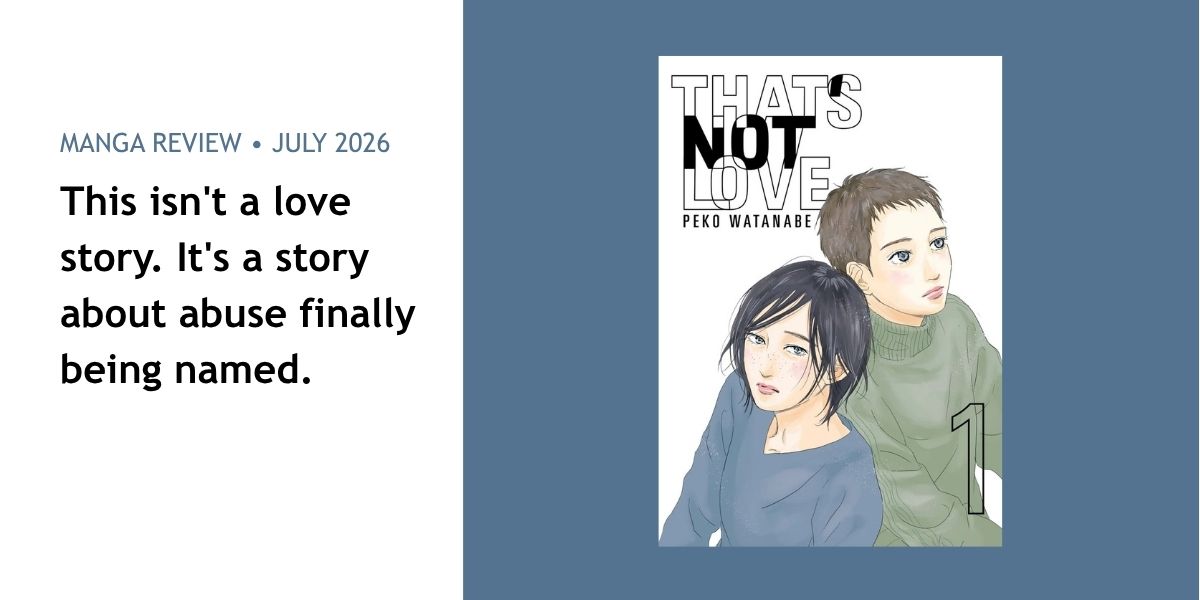
Peko Watanabe is one of those mangaka whose stories I genuinely love reading. That made me all the happier that one of her series is finally getting a print release in the US, since 1122 For Happy Marriage has so far only been available from the publisher as a digital edition.
That’s Not Love was originally published under the title Koi Ja Nee Kara from September 2021 to November 2024 in the seinen magazine Morning Two. The series consists of six volumes in total. The English-language license is held by Kodansha.
How was it?
That’s Not Love by Peko Watanabe is not a manga that can be consumed quickly. Its premise alone makes it clear that this is a heavy, mature drama dealing with themes such as grooming, sexual abuse, guilt, eating disorders, alcohol abuse, memory, and the question of consent. The first volume unfolds quietly, almost matter-of-factly, yet that very restraint makes its portrayal of wounds that can only truly be named decades later all the more powerful.
At the center of the story is forty-year-old Akane, who attends an exhibition by her former tutor, Imai, now a renowned sculptor. There, she discovers a sculpture that immediately feels familiar: it strongly reminds her of her former best friend Yukari, whom she was very close to in middle school before Yukari suddenly disappeared and transferred to another school. What is particularly unsettling is that the sculpture depicts a highly personal feature that Akane could only know because of how close she once was to Yukari.
This discovery refuses to let Akane go. She reaches out to Yukari and gradually begins to understand that what she had only partially grasped as a child was not a "special relationship" between a student and her teacher, but abuse. Yukari was fourteen years old at the time. Imai was an adult man and her teacher. What may once have been remembered—or even romanticized—as love is given a clearer and far more painful name from an adult perspective.
This shift in perspective is one of the manga's greatest strengths. That’s Not Love does not rely on a single shocking revelation where everything suddenly comes to light. Instead, it shows how understanding develops slowly. Akane remembers, reevaluates, and compares her childhood perceptions with the knowledge she has as an adult woman and mother. What she may once have interpreted as jealousy, secrecy, or something romantically special, she now recognizes as exploitation.
At the same time, Akane is far from a flawless savior. She carries wounds of her own. On the surface, her life appears stable: she is married, has a daughter, and works as a translator. But beneath that surface, much of her life is fragile. She struggles with alcohol, with her body image, with an eating disorder, and with the feeling that she has lost herself and the possibilities her life once held.
Particularly compelling is Akane's sense of guilt toward Yukari. She sensed that something was wrong back then, but she didn't understand it. Perhaps she didn't want to understand because she was jealous. Now she wants to help, but even that desire is not free of ambiguity. Is she apologizing because Yukari needs it? Or because she herself finally wants to be free of her own guilt? The manga allows room for these uncomfortable questions, making Akane feel believable and deeply human. She does the right thing, but not out of pure selflessness. She is shaken, angry, ashamed, and helpless all at once.
Yukari, meanwhile, is not portrayed as a one-dimensional victim. She has continued living her life. It has not been defined solely by what Imai did to her, but it has undeniably been shaped by it. That is an important distinction. That’s Not Love avoids the simplistic notion that trauma only ruins a person's life in one obvious, visible way. Instead, the manga shows that people continue working, building relationships, and functioning while still carrying something inside them that has never truly healed.
That is why being confronted with the sculpture again is so devastating for Yukari. It is not only about what happened all those years ago. It is about the fact that Imai is still profiting from her body decades later. An intimate depiction created when she was a minor is now publicly displayed and commodified as art. In doing so, Yukari loses control over her image and body for a second time. The manga makes one point unmistakably clear: art does not justify the absence of consent.
This aspect, in particular, makes the volume so powerful—and so infuriating. The question, "Is this art?" lingers in the air, but the manga redirects it toward the questions that truly matter: Who had the right to create this image? Who had the right to preserve it? Who had the right to exhibit it? Who profits from it? And who had to pay the price? Imai's wife defends the sculpture by appealing to art and his career, but in doing so she exposes a mechanism that feels disturbingly familiar. It is not only perpetrators who protect themselves; those around them often protect them as well.
The volume does an excellent job of showing how difficult it is to identify abuse of power in hindsight. Yukari was a child, yet she was manipulated into a situation that she herself was unable to fully recognize as abuse for many years. That is painfully realistic. Many survivors need years, sometimes decades, to understand what happened to them—not because it was objectively unclear, but because manipulation, shame, and self-blame can distort a person's own perception.
Thematically, That’s Not Love belongs among those manga that go far beyond mere entertainment. It asks how societies respond to abuse, particularly when it occurs within an apparently cultural or artistic context. It also examines how readily adults romanticize or downplay problematic relationships between teachers and underage female students. The manga scrutinizes this romanticization closely and dismantles it quietly but decisively.
This volume demands attention and emotional readiness. It tackles numerous heavy subjects at once: grooming, eating disorders, alcohol abuse, motherhood, unfulfilled life aspirations, guilt, art, and consent. That can be overwhelming. You need to be in the right frame of mind to engage with it. The content warning is absolutely warranted.
The title itself is fitting. That’s Not Love is not a subtle hint but a direct statement. What happened back then was not love. It was an abuse of power. It was grooming. It was an adult exploiting the vulnerability of a child.
Artistically, Peko Watanabe's style is a perfect match for the material. The artwork is not melodramatic but restrained, clear, and grounded in realism. The characters look like real adults—tired, vulnerable, and believable. There is no unnecessary aestheticization of suffering. For a manga that deals so directly with the sexualized gaze and the exploitation of a person's body, that restraint is essential.
Kodansha is publishing the manga in a larger trim format, and volume one opens with several color pages.
Is That's Not Love worth reading?
That’s Not Love is not an easy recommendation, but it is an important one. Anyone who currently lacks the emotional capacity to engage with themes such as abuse, eating disorders, or alcohol addiction should approach this volume with caution. However, readers willing to immerse themselves in a quiet, mature, and deeply serious drama will find a manga that lingers long after the final page and invites profound reflection.
That’s Not Love is an uncomfortable yet exceptionally well-told work about art, the body, memory, and the boundary that must never be crossed.

