
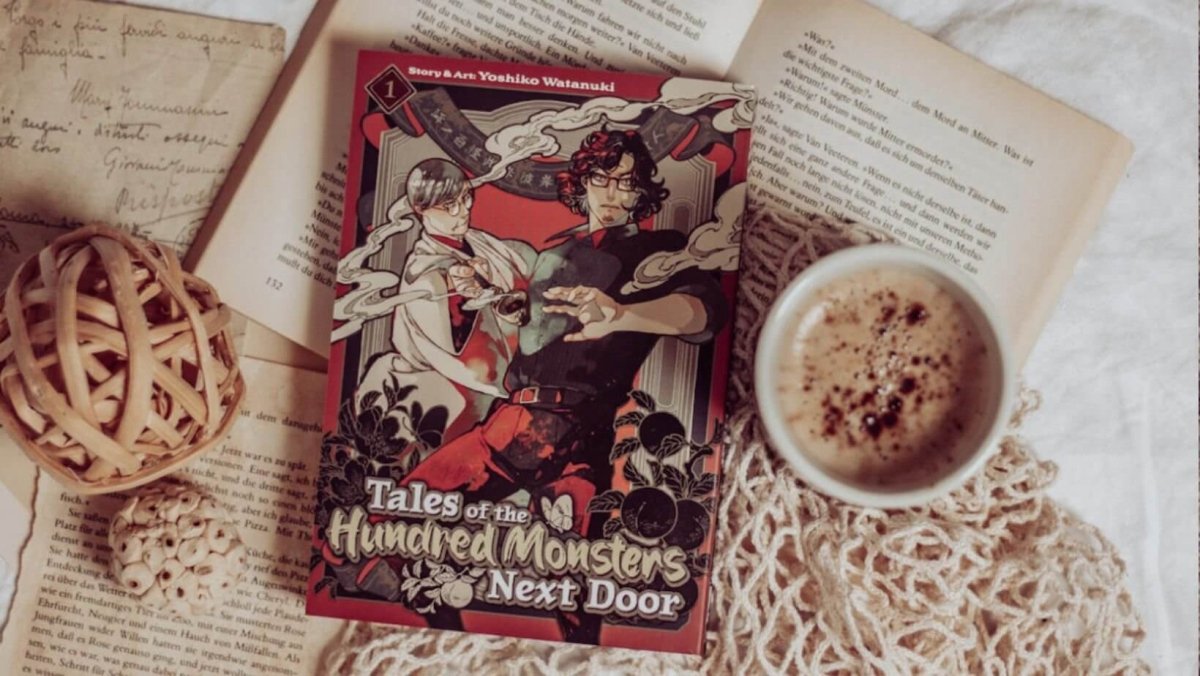
Fans of yokai stories will get their money’s worth with Seven Seas’ new release.
“Tonari no Hyakkai Kenbunroku,” as the series is called in Japanese, comes from the pen of Yoshiko Watanuki and has been published in Tonari no Young Jump since September 2022. As of January 2026, the series comprises three volumes in Japan. In the United States, only one volume has been released so far.
How was it?
“Tales of the Hundred Monsters Next Door” is a manga where, after just a few pages, you realize that it works less through a classic plot than through atmosphere, rhythm, and its own very particular way of telling “everyday life.” The world feels both modern and timeless, familiar and strange. And it is precisely this tension that makes it appealing.
At the center is Katagiri Jinpachi, a book cover designer whose life is rather uneventful. He loves routine, order, and the predictability of his daily life. But it is precisely this normality that makes him an ideal projection surface for the supernatural, because everything that happens to him stands in stark contrast to his sober, almost boring existence. With every encounter and every small incident, it becomes clear that Jinpachi has drawn the attention of another layer of reality. This is exactly what makes him an ideal identification figure: he stumbles into a world alongside the readers that he neither understands nor can control. His honesty and slight naivety make him a credible mediator between the reader and the world of yokai.
Harada Oriza plays a key role: an older painter and art professor who, because of his supposedly particularly realistic ghost paintings, carries the nickname “Ghost Sensei.” He moves through the occult with an unsettling ease, collecting strange stories and apparitions, and regards Jinpachi’s experiences more as fascinating material for observation than as something from which he should necessarily be protected. The relationship between the two is deliberately ambiguous. Harada helps, explains, hints at things, but never entirely without self-interest. Jinpachi, in turn, feels drawn to him both intellectually and emotionally, yet remains the uncertain one who never quite knows how much he can rely on this man.
One of the manga’s greatest strengths lies in its atmosphere. Every page feels carefully considered, and many panels have a visual power of their own that could almost stand alone. Even though everything is rendered in black and white, a strong sense of light emerges. Shadows, textures, and contrasts create depth and atmosphere without the manga ever feeling overloaded. This visual calm perfectly matches a story that relies less on plot than on atmosphere.
The story does not unfold in a strictly linear way, and connections are deliberately left vague. Events seem to overlap. This can be confusing, but it fits the theme very well. In terms of content, the story develops out of a very Japanese concept of ayakashi. Yokai, spirits, and strange phenomena do not appear as clearly separated beings from another world, but rather as something that can emerge from the narrow gap between the real world and another plane. Many of the situations described draw on feelings that almost everyone knows: the sense of being watched in a dark side street, seeing a figure that disappears the next moment, or feeling a presence without being able to name it. Precisely because these moments are so banal and everyday, they feel uncanny. The supernatural is therefore not an exception, but an extension of everyday life.
It is interesting how lavishly the food scenes are staged. One would not necessarily expect “food porn” in an eerie manga, but that is exactly what happens: pizza toast, thick slices of buttered bread, carefully placed cuts. These meals do not feel like decorative accessories, but rather like anchors in normality. And that is precisely what makes them so effective: between two strange events, you suddenly pause and simply look at a slice of toast.
Not everything works smoothly, however. Jinpachi remains comparatively pale as a character, at least in the first volume. He fulfills his role as observer and link to the reader’s perspective well, but develops only few contours of his own. Those who prefer strongly character-driven stories may initially feel a certain distance here. The non-linear structure and the deliberate refusal to provide clear answers can also be exhausting if one is looking for a linear narrative.
Seven Seas publishes the manga in the publisher’s standard paperback format. There are no extras such as color pages.
Is Tales of the Hundred Monsters Next Door worth reading?
Overall, the impression is that of a very distinctive, carefully composed work. “Tales of the Hundred Monsters Next Door” is not a manga you rush through. It invites you to read slowly. Anyone who enjoys quiet, atmospheric literature will definitely be well served here.