
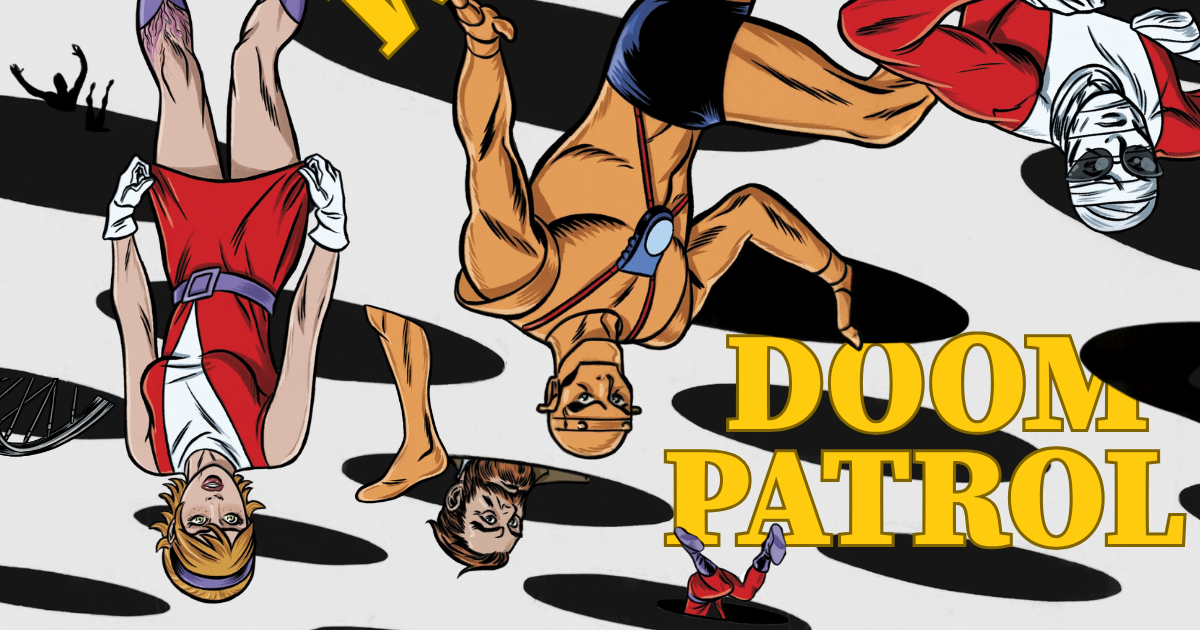
A wheelchair genius leads a team of misfits and outcast heroes: it cannot be anything else but Doom Patrol! Maybe you have seen the TV show or love the weird corners of the DC universe, like Vertigo. And now, you find yourself wondering where to start your journey with Doom Patrol comics. Breathe easy: you do not need to travel back to 1963!
One of the beautiful things about the team is that each run is very self-contained. You do not need to read everything in order. As a matter of fact, it’s probably best to jump straight into Grant Morrison’s Doom Patrol, since it is the most influential modern version.
Another entry would be Gerard Way’s Doom Patrol. DC’s Young Animal imprint served as a more modern, accessible way into the wacky world. And for those into DC’s Silver Age, you will want to go back to Doom Patrol’s debut in 1963 and My Greatest Adventure #80 with Arnold Drake, Bob Haney, and Bruno Premiani.
What Are the Doom Patrol Comics About?
What aren’t they about?! Doom Patrol comics have always been a sandbox for the weird and the broken, the bizarre and those who are unapologetically themselves. And that’s what makes them so versatile and different from writer to writer, from artist to artist.
Who Were the Original Doom Patrol Members?

The original team members of Doom Patrol are Robotman, Elasti-Girl, and Negative Man, led by Niles Caulder. They were individuals who got “cursed” by their abilities in some way. Excluded from society, they find family with each other and go on wacky sci-fi adventures.
When Did Doom Patrol First Appear?

The first appearance of Doom Patrol was in My Greatest Adventure #80. Until that point, the series served as an anthology, but writers Arnold Drake and Bob Haney and artist Bruno Premiani changed that for good. From issue #86, the title switched to The Doom Patrol.
Read the mentioned books
The original Doom Patrol begins
Swipe sideways to browse the books.
Where Should You Start Reading Doom Patrol?
Does this mean you need to go all the way back to My Greatest Adventure #80 when looking into where to start Doom Patrol comics? Not at all! Each creative team brought new members and a new spin to the title, so you should pick up what you like best.
For example, if you want the most influential modern Doom Patrol (which heavily influenced the show), then pick Grant Morrison. If you feel more like some classic DC history is in order, then give the Silver Age Doom Patrol a try. Rachel Pollack masterfully continued Morrison-era ideas but infused the run even further with queer themes and identity, introducing DC’s first trans superhero, Coagula.
If 90s goodness isn’t your thing and you’d prefer something even more modern, then it’s Gerard Way’s Doom Patrol that you want. It is a modern, colorful, pop-art revival of the team, focusing on therapy and healing. Finally, Unstoppable Doom Patrol and the recently released 2026 run are the newest mainstream DC versions of the team.
Best Starting Point for Most Readers: Grant Morrison

There is a reason why the most common answer to “How to start reading Doom Patrol” is simply two words: Grant Morrison. Their run began with issue #19 of the second volume, after the previous writer (Paul Kupperberg) agreed to write out the characters Morrison didn’t want.
Grant quickly establishes a new status quo for the team and introduces a plethora of new characters, like a girl with 65 personalities and powers or a cross-dressing sentient street. Their run is a true surrealist masterpiece, free of the Comics Code Authority and allowed to go wild. Superhero tropes are abandoned, and instead, you will dive deep into philosophy, trauma, and Dadaism.
The older characters were also altered beyond recognition, with Negative Man becoming a hermaphrodite Rebis, Robotman going through a different body every few issues, and Elasti-Girl becoming… a space god thing? Just turn off your brain and embrace the weird, and this run delivers!
Read the mentioned books
Grant Morrison reading options
Swipe sideways to browse the books.
Best Starting Point for Newer Comic Readers: Gerard Way

Gerard Way ushered in a pop-art revival of the title in 2016, which targeted a younger audience. Unlike the previous runs, which sometimes indulged in trauma, Gerard Way’s Doom Patrol focuses instead on healing and therapy, as well as millennial and Gen Z existentialism.
It is a wonderful modern successor to Morrison’s run, with a vibrant, psychedelic energy perfect for the 2010s. It is also the most welcoming and accessible Doom Patrol since Morrison, which makes this Doom Patrol comic a perfect place to start.
Read the mentioned books
Gerard Way reading options
Swipe sideways to browse the books.
Should You Start With the Silver Age?
While Drake, Haney, and Premiani’s work on the original Doom Patrol comic was revolutionary (the team premiered months before Marvel would launch the X-Men), the run relies on some very dated dialogue and pacing.
If you are a DC historian, you should check out these early issues for the team’s weird legacy. However, this is not where to start Doom Patrol comics for a more modern reader.
The Best Doom Patrol Runs to Read
As you are researching the best Doom Patrol runs, it can seem like a daunting task. There are just so many Doom Patrol comics out there! But worry not: here are some of the best runs to read.
Arnold Drake and Bruno Premiani: The Original Doom Patrol

What set Doom Patrol apart from other comics was how they treated their abilities from the start. While other people would dress up in colorful costumes, Doom Patrol members viewed their powers as horrifying afflictions instead.
From the get-go, this established the themes and set the team apart. They battled their monsters of the week but also fought existential dread and societal rejection. This is where the “heroes as freaks” trope truly began.
They also set themselves apart with how the run would end. Shockingly, the team was killed off to save 14 residents of a small Maine fishing town. This was the first time in history that a title did this upon its cancellation.
In another bit of trivia, Marvel’s X-Men debuted just months later with a nearly identical premise. Arnold Drake famously suspected Stan Lee of “borrowing” the concept for the team, though, of course, nothing can be proven after all this time.
Read the mentioned books
The original Doom Patrol
Swipe sideways to browse the books.
Grant Morrison and Richard Case: The Essential Modern Run


There could be pages and pages of essays written about Grant Morrison and Richard Case’s seminal run on the Doom Patrol. The run was revolutionary (it seems that Doom Patrol often oscillates between that and total devastation) and shook the comic world to its core.
Grant used Dadaism and surrealism as weapons and sharpened them against the wheel of mental illness, gender identity, and childhood abuse. These were not just background elements of a character’s backstory anymore, but weapons they could use to save the world.
Richard Case, meanwhile, poured every bit of magic into his pencils. Somehow, he was able to ground all of Morrison’s immensely incorporeal concepts and showcase them in their full visceral reality.
Grant Morrison’s Doom Patrol is therefore a misnomer, since it’s the work of both (and many more!), but it should be read by everyone. A piece of advice: embrace the insanity and just keep going, no matter how confusing it gets!
Read the mentioned books
Grant Morrison and Richard Case
Swipe sideways to browse the books.
Rachel Pollack: The Underrated Follow-Up

Rachel Pollack had the very unenviable task of following in the huge footprints left by Grant Morrison. And lucky for us, she delivered on all fronts. So how do you continue the story? By taking the themes and twisting them inward.
Where Morrison’s run steers outward, exploring often extraterrestrial concepts, Pollack’s run is deeply introspective. She leaned heavily into queer identity and kept exploring bodily autonomy, which Morrison could be accused of tackling somewhat inelegantly.
Pollack’s run also sees characters finding joy in the community they are building, and Ted McKeever and Linda Medley deliver art that pulled the story even further away from traditional superhero antics with its stylized, exaggerated, and sometimes grotesque flair. It’s as progressive a comic as you could get in the 90s.
Read the mentioned books
Rachel Pollack's follow-up
Swipe sideways to browse the books.
Gerard Way and Nick Derington: Young Animal Doom Patrol

In 2016, DC presented a new “pop-up” imprint, Young Animal. It was aimed at mature readers, relaunching some of the forgotten characters and settings, and was developed by Gerard Way, Vertigo group editor Jamie S. Rich, and Mark Doyle.
The first four series were Shade the Changing Girl, Cave Carson Has a Cybernetic Eye, Mother Panic, and, of course, Doom Patrol, written by Gerard Way, with Nick Derington on art. This run was, as mentioned, a relaunch of the team, inspired by Morrison’s Doom Patrol decades prior.
Similarly to Morrison, who based their run in Dada, Way based his in Pop Art. However, the themes were more akin to what Pollack did: found family, therapy, acceptance, with a sprinkle of modern Gen Z philosophy.
Derington understood the assignment well and delivered on the art. It’s vibrant and psychedelic, yet very clean. The book feels modern, and it’s a blast to go through every time.
Read the mentioned books
Young Animal Doom Patrol
Swipe sideways to browse the books.
Dennis Culver and Chris Burnham: Unstoppable Doom Patrol

One of the criticisms of Doom Patrol comics is that the team can be very reactive. Weird things happen to them and around them, while they often take agency only toward the end of their stories. Dennis Culver changed this by making them very proactive. His Doom Patrol actively hunts down weirdness to try to save new metahumans before they end up in a place like Arkham Asylum.
Another change is that Culver firmly anchors the team in the DC universe, having them clash with heroes like Batman, Green Lantern, and the rest. Meanwhile, Burnham’s art is reminiscent of Frank Quitely, capturing kinetic body horror with utmost precision.
Read the mentioned books
Unstoppable Doom Patrol
Swipe sideways to browse the books.
Doom Patrol Comics Reading Order
Now that we have tackled the best and the brightest of the Doom Patrol comics, it’s time to check them out in order. You can use this as a reading order if you are a historian and comfortable with weird narrative shifts.
1. The Original/Silver Age Doom Patrol
You start with My Greatest Adventure #80 and then keep reading forward. The title ran for just 5 more issues, and then, instead of My Greatest Adventure #86, it was called Doom Patrol #86.
The best way to read this is to grab the Doom Patrol: The Silver Age Omnibus or the two DC Finest volumes collecting the run.
Read the mentioned books
Silver Age Doom Patrol
Swipe sideways to browse the books.
2. The Pre-Morrison Revival
Writer Paul Kupperberg was a longtime fan of the series, and with artist Joe Staton, he introduced the new team in Showcase #94. The run was short-lived (only 21 issues or so), with many crossovers, all of which are collected in the Doom Patrol: The Bronze Age Omnibus.
3. Grant Morrison’s Doom Patrol
When Grant Morrison inherited the title with Doom Patrol #19, they were given free rein and even encouragement from DC to change things around. And change they did. The run is considered a masterpiece by many (deservedly so), and it veered in wild directions. The complete run is in The Doom Patrol Omnibus by Grant Morrison or in a series of trade paperback books.
Read the mentioned books
Grant Morrison reading order
Swipe sideways to browse the books.
4. Rachel Pollack’s Doom Patrol
If you loved Morrison’s Doom Patrol, you will love Pollack’s team as well. She leaned heavily into the queerness of the team, both literal and otherwise. While it was not a favorite as it was coming out, the run became well-regarded retroactively. It’s fully collected in the Doom Patrol by Rachel Pollack Omnibus as well as DC Finest: Doom Patrol: The End Sanctifies the Means.
Read the mentioned books
Rachel Pollack reading order
Swipe sideways to browse the books.
5. The 2000s Doom Patrol Series

After Rachel Pollack, the team went through many iterations and creative teams in the 2000s. The reason why these are often overlooked is that the quality was not as stellar as that of the previous runs. These runs are only recommended for completionists!
Volume 3’s 22 issues aren’t collected yet. Volume 4 was done by John Byrne and is collected in the respective omnibus. Keith Giffen and Matthew Clark tackled Volume 5, which is collected in omnibus format as well.
Read the mentioned books
2000s Doom Patrol collections
Swipe sideways to browse the books.
6. Gerard Way’s Doom Patrol
Doom Patrol comics sadly faded into somewhat of an obscurity in the 2000s until Gerard Way came along. He understood what the team represents, and his Young Animal series is therefore stellar. Sadly, the run was very short and is collected in Doom Patrol by Gerard Way and Nick Derington: The Deluxe Edition, as well as two trade paperbacks. (The Deluxe also contains the Doom Patrol: Weight of the Worlds mini.)
Read the mentioned books
Gerard Way reading order
Swipe sideways to browse the books.
7. Unstoppable Doom Patrol
Finally, Unstoppable Doom Patrol marks Volume 7 of the series. Dennis Culver and Chris Burnham championed disability rights and treated each “monster of the week” as a patient to be treated instead. The whole run is short (7 issues) and collected in a single trade paperback.
Read the mentioned books
Unstoppable Doom Patrol reading order
Swipe sideways to browse the books.
The Doom Patrol (DC Next Level)

Just recently, a new Doom Patrol ongoing has started under the pen of writer Darcy Van Poelgeest and artist Niko Henrichon. This run sees the original team of Robotman, Elasti-Girl, and Negative Man reunited and broke. Our heroes-for-hire get a job saving a cat... and in true Doom Patrol fashion, things explode exponentially... Get on the title while it's fresh off the press!
Read the mentioned books
The new Doom Patrol ongoing
Swipe sideways to browse the books.
Doom Patrol Comics vs. the TV Series

If you are coming into this article after watching the TV series, you might be wondering what the biggest differences are between Doom Patrol comics vs. the show. As it always is with TV media, the show takes inspiration from different eras, so there is no direct 1-to-1 adaptation.
However, you will be familiar with the characters and concepts. Just note that significant changes will occur. Morrison’s run, for example, serves as a huge inspiration, introducing the character of Crazy Jane into the fold. However, Morrison doesn’t deal with Elasti-Woman or Negative Man. They are very different in this run.
Another good run to jump into after enjoying the show is Gerard Way’s run. It is the most seamless and accessible entry, perfectly capturing the tone and absurdity of the story.
Which Doom Patrol Run Should You Read First?
Your first Doom Patrol comic should be based on what you want from the title. I would advise most readers to go with Grant Morrison’s Doom Patrol. If you enjoyed that, then go straight into Rachel Pollack. If modern accessibility is what you’re looking for, then Gerard Way is the way. For short and sweet, get Unstoppable Doom Patrol. If you’re a history buff, then grab Arnold Drake and Bruno Premiani.
Whatever you pick, you will have a bizarre yet great time. Keep in mind: every run is its own thing rather than years and years of stories. So, you do not need to stress about chronology or order. Doom Patrol welcomes everyone and makes sure they become a part of the family.


